
What Actually Makes Insulated Bottles Keep Stuff Hot or Cold? (Part 8)
Stories live in cups, warmth resides in life. Hi everyone, welcome back to "Dong Dong's Cup Talk". I have explained the truths behind a tumbler’s heat and cold retention performance in many previous posts. https://www.umbottle.com/ProductsDetail-VB-10376.htmlGiven that thousands of articles have been published over an extended period, many readers find it difficult to locate those earlier write ups. Today, I revisit this topic from a more comprehensive perspective.
As always, this subject covers extensive information, so I will divide it into multiple installments. If you find these insights helpful for picking your sports water bottle, kindly give this post a like. https://www.umbottle.com/ProductsDetail-VB-10376.htmlPlease follow me for more cup related content; your support is greatly appreciated.
Why can two tumblers that look identical and feature identical specifications perform so differently? One keeps water hot reliably for 12 hours, while the other turns completely cold within half a day.
There is another confusing phenomenon for most users: no matter how expensive the tumbler is, its cold retention performance always surpasses its heat retention performance. https://www.umbottle.com/ProductsDetail-VB-10376.htmlMerchants barely mention this fact, and many consumers mistakenly believe their cup is faulty.
Why Cold Retention Always Outlasts Heat Retention? Are There Reverse Performance Tumbler Designs?
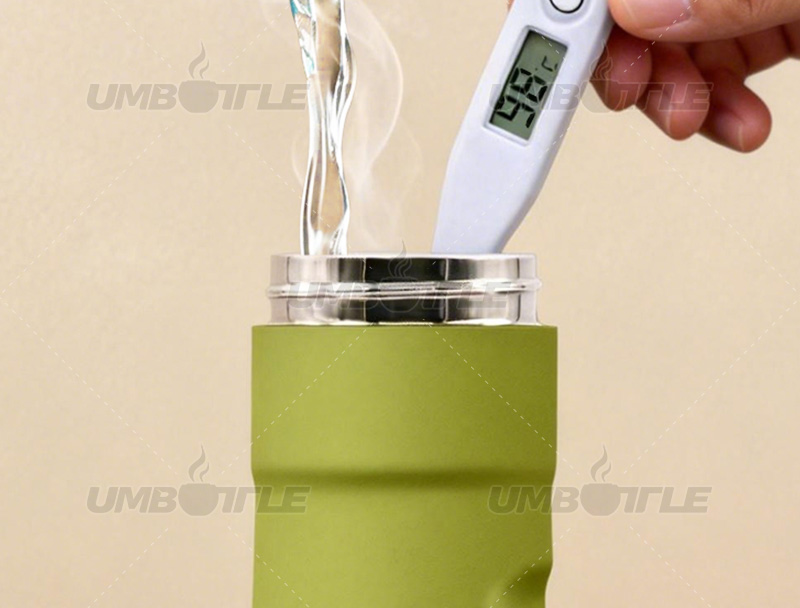
1. Core Principle (Supported by Newton’s Law of Cooling, an established physical theory) The rate of all heat transfer is governed by the temperature difference between the inside and outside of the medium. The larger the temperature gap, the faster thermal exchange proceeds. Under standard 22 °C ambient conditions: boiling water at 95 °C creates a 73 °C temperature difference against surroundings, https://www.umbottle.com/ProductsDetail-VB-10376.htmlwhile ice cold water at 4 °C only generates an 18 °C difference. Calculations show hot water dissipates heat outward roughly four times faster than ice cold water absorbs heat and warms up. This is an irreversible physical law.
2. Direct Evidence from Practical Test Data A standard 500 ml tumbler with screw in inner stopper was tested under national standard conditions: After 12 hour heat retention test: water temperature reaches 48 °C After 12 hour cold retention test: water temperature reaches 8 °C After 24 hour heat retention test: water temperature drops to 25 °C (near ambient temperature) After 24 hour cold retention test: https://www.umbottle.com/ProductsDetail-VB-10376.htmlwater remains at 12 °C (still icy and usable) Cold retention performance consistently outperforms heat retention throughout the test cycle.
3. Do tumblers exist with better heat retention than cold retention? Under normal room temperature usage, no mass produced vacuum tumbler can deliver superior heat retention over cold retention. https://www.umbottle.com/ProductsDetail-VB-10376.htmlOnly under extreme special conditions (outdoor severe cold of 15 °C), the temperature gap between ice cold water and frigid surroundings widens sharply while the gap for hot water shrinks. Cold retention will degrade faster temporarily. This is an extreme edge case and offers no reference for everyday use.
There are stories in the cup, and life has warmth. Use the right cup and choose the right factory. We have dozens of patented cup and pot products and provide OEM services to the world. We have dozens of professional engineers who provide cup and pot product development services to the world. We have multiple complete current cup and pot product production lines to provide OEM services to the world. Dongguan Zhan Yi Commodity Technology Co.,Ltd. attaches great importance to contracts and quality. We welcome global merchants to conduct on-site factory inspections and in-depth cooperation.