
Spray Coating vs Powder Coating for Drinkware (Part 3)
Every drinking cup holds a story, and everyday life is filled with warmth. Hello everyone, welcome back to "Dong Dong's Cup Talk"
As I shared previously, many original articles I authored were falsely marked as AI-generated across online platforms without valid grounds. Recently, I found my years-old post covering spray coating had been removed from site archives with no recourse for appeal. https://www.umbottle.com/ProductsDetail-VB-10349.htmlI am rewriting the content now to test whether it gets deleted again, treating the rewrite as valuable practice to hone my writing skills.
Consumers have divergent preferences between spray coating and powder coating for water cups: some prefer glossy finishes, others textured surfaces, and many prioritize a soft, pleasant hand feel. From a personal preference perspective, https://www.umbottle.com/ProductsDetail-VB-10349.htmlneither finishing process is inherently superior to the other. Even so, countless friends and readers keep posing two core questions: Which finish is better for drinking cups, spray coating or powder coating? Why do some cups lose their coating after long-term use while others remain highly durable?
I will elaborate thoroughly from an in-factory production viewpoint in this series. Due to the extensive content, the material will be split into multiple installments. Follow Dongdong’s Cup Talk to receive instant alerts for all subsequent updates. https://www.umbottle.com/ProductsDetail-VB-10349.htmlIf you find my content helpful, kindly share and like this post—I appreciate your support in advance!
We will dive deeper into practical know-how about spray coatings, a great learning opportunity for young professionals in the industry. https://www.umbottle.com/ProductsDetail-VB-10349.htmlThe technical details are fairly comprehensive, so dedicated learners are advised to go through the text repeatedly; feel free to leave a comment below for any unresolved questions.
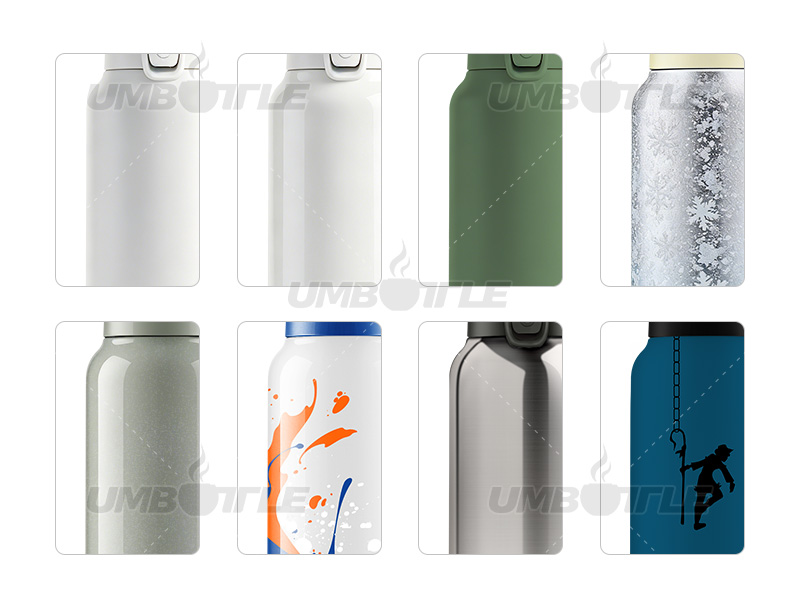
Based on my on-site factory experience, spray coatings fall into eight core categories: matte coating, high-gloss coating, soft-touch coating, special textured coating, pearlescent coating, heat transfer sublimation, clear high-gloss varnish and clear matte varnish. https://www.umbottle.com/ProductsDetail-VB-10349.htmlEach variant differs in appearance, tactile performance and production specifications, with manufacturers selecting coating types according to client requirements and cost budgets.
1. Matte Coating
Features: 60° gloss value ranging from 5% to 30%; smooth non-reflective surface delivering an understated premium look. Its scratch resistance is marginally better than high-gloss alternatives.
Processing Specifications: Apply thin, uniform primer coat; blend 1%–5% matting powder into topcoat. Standard curing temperature sits between 60℃ and 80℃. https://www.umbottle.com/ProductsDetail-VB-10349.htmlExcessively high heat triggers yellowing, while insufficient temperature causes inconsistent gloss. Most manufacturers raise the temperature to 90–110℃ to shorten production cycles.
2. High-Gloss Coating
Features: 60° gloss ≥80% with mirror-like high reflectivity and exquisite aesthetics; prone to fingerprint accumulation and obvious scratch marks.
Processing Specifications: Substrate ideally requires mirror-grade polishing (fully polished blanks are rarely available in practice). https://www.umbottle.com/ProductsDetail-VB-10349.htmlSpraying must be completed inside a dust-free workshop to prevent granular blemishes. Topcoat needs excellent levelling property; cure at 70–90℃ to avoid sagging. For faster throughput, most factories adopt 90–110℃ baking temperature.
3. Soft-Touch Coating (Leather-Feel / Elastic Coating)
Features: Predominantly matte finish with velvety, skin-like elastic texture similar to baby skin; anti-slip and exceptionally comfortable to grip.
Processing Specifications: Double-coat construction is mandatory: primer improves substrate adhesion, and topcoat adopts elastic polyurethane resin. https://www.umbottle.com/ProductsDetail-VB-10349.htmlCure at 50–60℃; overheating hardens the film and eliminates the signature soft tactile effect.
4. Special Textured Coating
Features: Custom finishes including granular, brushed and frosted textures; effectively conceals base material defects while delivering strong anti-slip performance and premium texture.
Processing Specifications: https://www.umbottle.com/ProductsDetail-VB-10349.htmlMix quartz sand or mica flakes into coating liquid; equip spray guns with larger nozzle bore and extend spraying distance to avoid particle agglomeration. Cure at a steady 80℃ to prevent texture deformation.
5. Pearlescent Coating
Features: Formulated with pearlescent pigment flakes; generates delicate iridescent luster under light refraction resembling natural pearl for upscale visual effects.
Processing Specifications: https://www.umbottle.com/ProductsDetail-VB-10349.htmlUtilize fine pearlescent powder (5–10μm particle size) with full uniform dispersion; apply multiple thin topcoats to avoid uneven color shading. Bake at 60–70℃ to stop pigment discoloration.
6. Heat Transfer Sublimation
Features: Not a standalone spray coating process; decorative patterns are thermally transferred onto pre-coated surfaces with crisp, vivid color and robust abrasion resistance against peeling.
Processing Specifications: https://www.umbottle.com/ProductsDetail-VB-10349.htmlFirst spray a base high-gloss white primer as underlayer before pattern transfer. Standard transfer parameters: 180–200℃ for 30–60 seconds. Low temperature leads to poor pattern adhesion, whereas excessive heat causes yellow discoloration.
7. Clear High-Gloss Varnish
Features: Transparent clear coat applied over printed graphics or colored base coats to boost gloss, prevent scratching and shield decorative layers.
Processing Specifications: https://www.umbottle.com/ProductsDetail-VB-10349.htmlSingle thin coat with superior levelling performance; cure at 70–80℃. Over-thick film cracks easily, while overly thin coating fails to deliver sufficient surface protection.
8. Clear Matte Varnish
Features: Transparent matte clear coat laid atop printed artwork for low-key styling with anti-fingerprint and anti-slip functions.
Processing Specifications: Blend matting powder evenly into varnish before uniform spraying; cure at 60–70℃ to eliminate uneven gloss issues.
There are stories in the cup, life has warmth, use a good cup to enjoy a healthy life. We provide OEM business to more than 100 companies around the world, and produce more than 3 million pieces of various stainless steel/plastic cups and pots annually. Honoring promises, keeping reputation, ensuring quality and quantity, and delivering on time are our service principles and our professional commitment. Dongguan Zhan Yi Commodity Technology Co.,Ltd. welcomes global merchants to conduct on-site factory inspections and in-depth cooperation.