
Why Do Stainless Steel Water Cups Still Rust? (Part 5)
Every cup carries a story, and life is filled with warmth. Hello everyone, welcome back to "Dong Dong's Cup Talk" Talks Cups. Recently, I’ve noticed a noticeable drop in indexed pages on our company website. After further investigation, I learned that many of our previously published articles had been removed for being flagged as AI-generated content, which is quite frustrating. I started creating content about the industry and related products back in 2020, long before AI writing tools came into widespread use. When these AI tools first launched, we even ran tests on them, and surprisingly, some of their generated content was copied straight from my writings.
There is no way to get around the platform rules for AI content, so I have to rewrite all the deleted articles. Even so, it is not a bad thing. It gives me a chance to https://www.umbottle.com/ProductsDetail-VB-10456.htmlreflect on the flaws in my previous writing. With years of professional knowledge accumulated, I can now explain the same topics in a more thorough manner.
Today, let’s continue to explore why stainless steel water cups tend to rust. I manage accounts with the same name across various social media platforms. On Xiaohongshu, I’ve received countless messages asking why cups made of stainless steel develop rust. Let me clarify this once again: stainless steel is only rust-resistant, https://www.umbottle.com/ProductsDetail-VB-10456.htmlnot completely rust-proof. Every material has its functional limits. Once overstepped, it will fail to perform as expected.
I have summed up five major causes of rust on stainless steel water cups, and I will share each one in a separate post due to the length of the content. Follow my account to learn all the details, and feel free to give a https://www.umbottle.com/ProductsDetail-VB-10456.htmllike if you find this content helpful.
Cause 5: Improper Cleaning Methods — Well-Meaning Actions That Accelerate Rusting
I receive the most inquiries about this issue. Many people try to maintain their cups with good intentions, yet end up making them more prone to rust. The most common mistake is soaking a new cup in salt water.
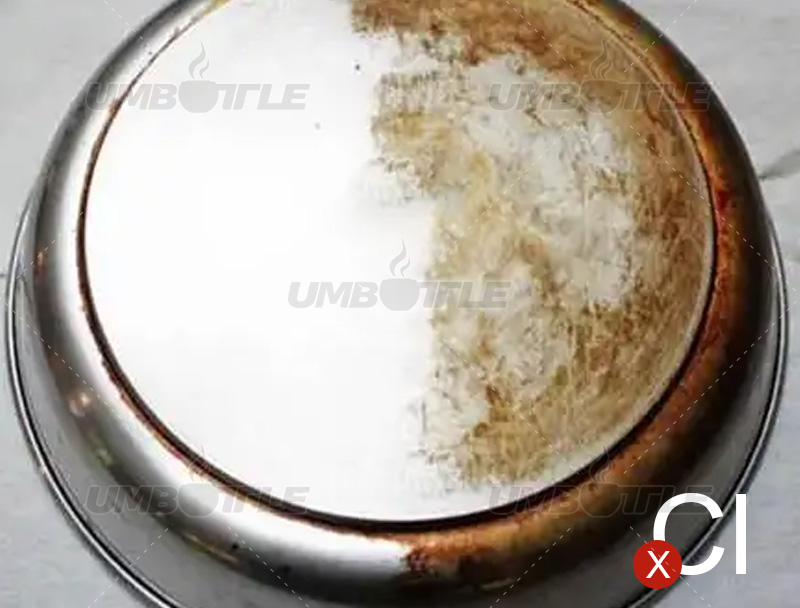
Many people believe soaking a new cup in salt water can disinfect it and remove odors. However, after soaking for hours, they find the inner wall turns dark and dull, losing its smooth finish, and even develops tiny rust spots. This is not a quality defect of the cup, but a result of wrong cleaning methods.
Stainless steel is highly vulnerable to chloride ions, and salt water contains a large amount of such ions. The protective film on the inner wall of a new cup is still relatively fragile. Long-time soaking in salt water allows chloride ions to erode the protective layer, causing oxidation and discoloration. Severe cases will lead to https://www.umbottle.com/ProductsDetail-VB-10456.htmldirect rusting. This kind of corrosion is irreversible, and the cup can never return to its original condition no matter how you clean it later.
Apart from salt water, scrubbing the inner wall hard with steel wool or stiff brushes will scratch the protective coating. Once the coating is damaged, water and air will come into direct contact with the stainless steel and https://www.umbottle.com/ProductsDetail-VB-10456.htmltrigger rusting. Using strong acidic or alkaline cleaners such as toilet cleaners and descaling agents will also corrode the inner surface and cause rust.
Correct Cleaning Guidelines
The proper way to clean a new cup is simple: use warm water mixed with a small amount of neutral detergent like dish soap. Gently wipe the inner wall and lid with a soft cloth, rinse thoroughly and leave it to dry. There is no need for salt water soaking at all.
For daily cleaning, stick to soft cloths or sponges. Never use steel wool or stiff brushes, and always choose neutral cleaners instead of strong acids or alkalis.
If your cup has turned dark or developed rust after salt water soaking, its protective layer has been permanently damaged. It is recommended to replace it for the sake of your health.
There are stories in the cup, life has warmth, use a good cup to enjoy a healthy life. We provide OEM business to more than 100 companies around the world, and produce more than 3 million pieces of various stainless steel/plastic cups and pots annually. Honoring promises, keeping reputation, ensuring quality and quantity, and delivering on time are our service principles and our professional commitment. Dongguan Zhan Yi Commodity Technology Co.,Ltd. welcomes global merchants to conduct on-site factory inspections and in-depth cooperation.